pydecode.transform
Examples
import pydecode
import numpy as np
items = np.arange(11)
chart = pydecode.ChartBuilder(items)
chart.init(items[0])
chart.set(items[5], [[0] for i in range(5)], np.arange(5) % 3)
chart.set(items[10], [[5] for i in range(5)], np.arange(5) % 3)
graph = chart.finish()
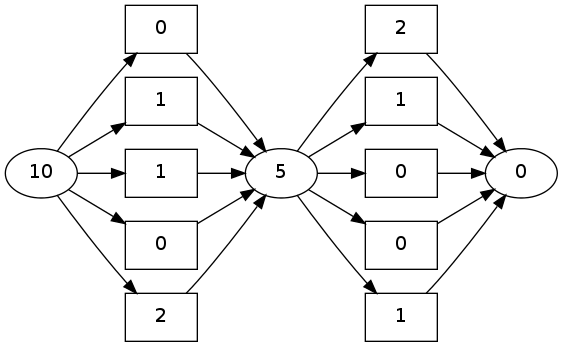
pydecode.draw(graph, labels=True)
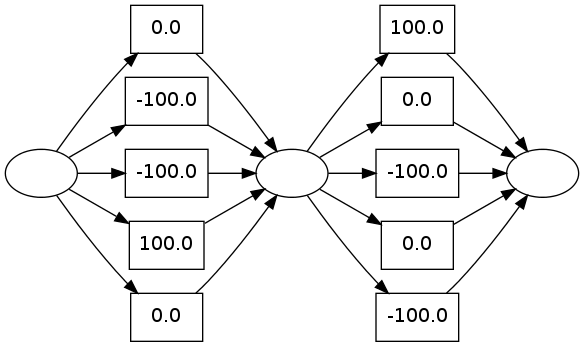
values = np.array([-100, 0, 100])
weights = pydecode.transform(graph, values)
pydecode.draw(graph, weights)
marginals = pydecode.marginals(graph, values * 1.)
print pydecode.inverse_transform(graph, marginals)
[ 1.17365385e+214 1.17365385e+214 1.17365385e+214]
Invariants
Check that the transforms are invertible.
import numpy.testing as test
import pydecode.test.utils as test_utils
graph, _, weight_type = test_utils.random_setup()
size = np.max(graph.labeling) + 1
label_weights = test_utils.random_weights(weight_type, size)
weights = pydecode.transform(graph, label_weights, weight_type=weight_type)
Weight transform.
weights2 = np.zeros(len(graph.edges))
weights2.fill(weight_type.Value.one_raw())
for i, label in enumerate(graph.labeling):
    if label == -1: continue
    weights2[i] = label_weights[label]
test.assert_almost_equal(weights, weights2, 5)
Reverse transform.
weights = test_utils.random_weights(weight_type, len(graph.edges))
label_weights = pydecode.inverse_transform(graph, weights, weight_type=weight_type)
label_weights2 = [weight_type.Value.zero()] * size
for i, label in enumerate(graph.labeling):
    if label == -1: continue
    label_weights2[label] += weight_type.Value(weights[i])
label_weights2 = np.array([weight.value for weight in label_weights2])
test.assert_almost_equal(label_weights, label_weights2, 5)