Tutorial 3: HMM Tagger
This tutorial extends edit distance to a richer decoding problem, part-of-speech tagging.
import pydecode
import pandas as pd
import matplotlib.pyplot as plt
import numpy as np
For this example, we assume a toy part-of-speech tagging model. Our model will be a simple bigram hidden Markov model, with boundary states START and END.
tags = ["START", "D", "N", "V", "END"]

# The emission probabilities.
emission = {'START' : {'START' : 1.0},
            'the' :  {'D': 0.8, 'N': 0.1, 'V': 0.1},
            'dog' :  {'D': 0.1, 'N': 0.8, 'V': 0.1},
            'walked':{'V': 1},
            'in' :   {'D': 1},
            'park' : {'N': 0.1, 'V': 0.9},
            'END' :  {'END' : 1.0}}

# The transition probabilities.
transition = {'D' :    {'D' : 0.1, 'N' : 0.8, 'V' : 0.1, 'END' : 0},
              'N' :    {'D' : 0.1, 'N' : 0.1, 'V' : 0.6, 'END' : 0.2},
              'V' :    {'D' : 0.4, 'N' : 0.3, 'V' : 0.2, 'END' : 0.1},
              'START' : {'D' : 0.4, 'N' : 0.3, 'V' : 0.3},
              'END': {'END' : 1.0}}
T = pd.DataFrame(transition).fillna(0)
E = pd.DataFrame(emission).fillna(0)
print T
print E
       D  END    N  START    V
D    0.1    0  0.1    0.4  0.4
END  0.0    1  0.2    0.0  0.1
N    0.8    0  0.1    0.3  0.3
V    0.1    0  0.6    0.3  0.2
       END  START  dog  in  park  the  walked
D        0      0  0.1   1   0.0  0.8       0
END      1      0  0.0   0   0.0  0.0       0
N        0      0  0.8   0   0.1  0.1       0
START    0      1  0.0   0   0.0  0.0       0
V        0      0  0.1   0   0.9  0.1       1
Here is the PyDecode implementation of the Viterbi algorithm for tagging.
def ungrid(items, shape):
    return np.array(np.unravel_index(items, shape)).T
def viterbi(n):
    t = len(tags)
    # Initialization.
    items = np.arange(n * t).reshape([n, t])
    outputs = np.arange(n * t * t).reshape([n, t, t])
    c = pydecode.ChartBuilder(items, outputs)

    # The tags allowed at each position.
    K = [[0]] + [range(1, t-1)] * (n-2) + [[t-1]]

    # Viterbi.
    c.init(items[0, K[0]])
    for i in range(1, n):
        for t in K[i]:
            c.set_t(items[i, t],
                    items[i-1, K[i-1]],
                    labels=outputs[i, t, K[i-1]])
    return c.finish()
# A sentence to be tagged.
sentence = 'START the dog walked in the park END'.split()
n = len(sentence)
graph = viterbi(n)
# vertex_labels = pydecode.vertex_items(dp)
# display.HypergraphFormatter(dp.hypergraph, vertex_labels=vertex_labels, show_hyperedges=False).to_ipython()
pydecode.draw(graph, None, ungrid(graph.node_labeling, shape=(n,len(tags))))
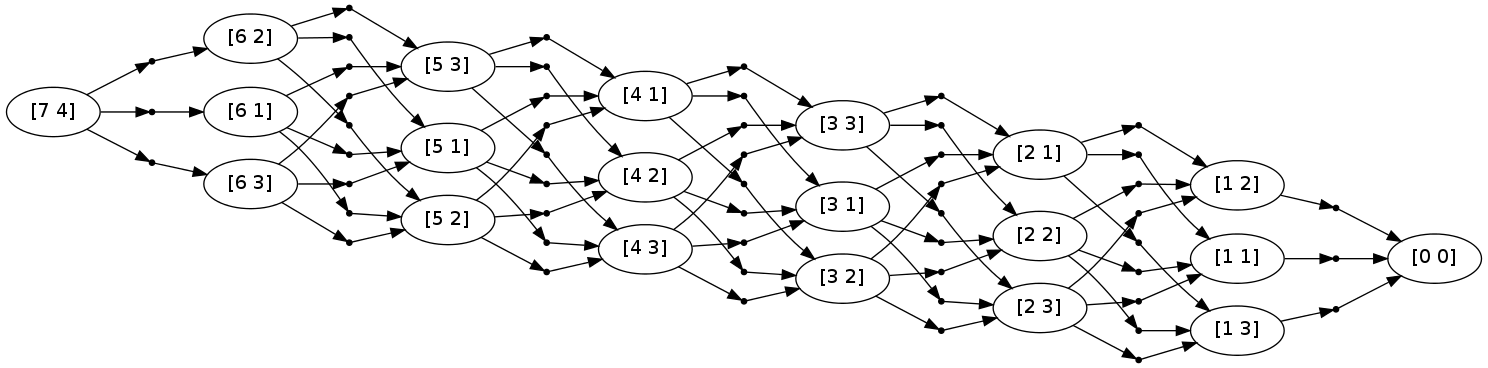
To make the scores we again compute a value for each of the possible outputs.
def make_scores(words, n_tags):
    n = len(words)
    shape = (n, n_tags, n_tags)
    scores = np.zeros(shape)
    for i, tag, prev_tag in np.ndindex(shape):
        scores[i, tag, prev_tag] = \
            transition[tags[prev_tag]].get(tags[tag], 0.0) * \
            emission[words[i]].get(tags[tag], 0.0)
    return scores
scores = make_scores(sentence, len(tags))
weights = pydecode.transform(graph, scores)
path = pydecode.best_path(graph, weights, weight_type=pydecode.Viterbi)
path
<pydecode._pydecode.Path at 0x434a2c0>
inside = pydecode.inside(graph, weights, weight_type=pydecode.Real)
root_prob = inside[graph.root.id]
marginals = pydecode.marginals(graph, weights, weight_type=pydecode.Real,
                               inside_chart=inside)
normalized_marginals = marginals / root_prob
m = min(normalized_marginals)
M = max(normalized_marginals)
import pydecode.display
class HMMFormat(pydecode.display.HypergraphPathFormatter):
    def label(self, node):
        label = self.vertex_labels[node.id]
        return "%d %s"%(label[0], tags[label[1]])
    def hyperedge_node_attrs(self, edge):
        return {"color": "pink", "shape": "point"}
    def hypernode_subgraph(self, node):
        return [("cluster_" + str(self.vertex_labels[node.id][0]), None)]
    def subgraph_format(self, subgraph):
        return {"label": (sentence)[int(subgraph.split("_")[1])],
                "rank" : "same"}
    def graph_attrs(self): return {"rankdir":"RL"}

    def hypernode_attrs(self, node):
        return {"shape": "",
                "label": self.label(node),
                "style": "filled",
                "fillcolor": "#FFFF%d"%(int(((normalized_marginals[node.id] - m) / (M-m)) * 100))}

pydecode.draw(graph, None, ungrid(graph.node_labeling, shape=(n,len(tags))),
              formatter=HMMFormat(graph))

tags
['START', 'D', 'N', 'V', 'END']