pydecode.inside
Example
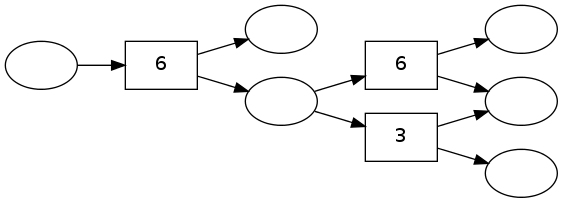
This examples creates a simple hypergraph with random integer weights, and overlays the inside scores onto the graph for several different weight types.
import pydecode
import pydecode.test.utils
import numpy as np
graph = pydecode.test.utils.simple_hypergraph()
weights = np.random.randint(10, size=(len(graph.edges)))
pydecode.draw(graph, weights)
inside = pydecode.inside(graph, np.array(weights, dtype=np.double),
                weight_type=pydecode.LogViterbi)
pydecode.draw(graph, weights, inside)

inside = pydecode.inside(graph, np.array(weights, dtype=np.int32),
                         weight_type=pydecode.Counting)
pydecode.draw(graph, weights, inside)

inside = pydecode.inside(graph, np.array(weights > 5, dtype=np.int8),
                weight_type=pydecode.Boolean)
pydecode.draw(graph, weights, inside)

Invariants
import numpy.testing as test
import pydecode.test.utils as test_utils
graph, weights, weight_type = test_utils.random_setup()
inside = pydecode.inside(graph, weights, weight_type=weight_type)
Scores in the chart represent the sum of all inside path.
for vertex in graph.vertices:
    if vertex.is_terminal:
        score = weight_type.Value.one()
    else:
        score = weight_type.Value.zero()
        for path in test_utils.inside_paths(graph, vertex):
            score += test_utils.path_score(path, weights, weight_type)
    test.assert_almost_equal(inside[vertex.id], score.value, 5)
Check that the inside score of a vertex is the sum of its direct children.
inside2 = np.zeros(inside.shape, dtype=np.double)
inside2.fill(weight_type.Value.zero_raw())
for vertex in graph.vertices:
    if vertex.is_terminal:
        inside2[vertex.id] = weight_type.Value.one().value
    else:
        score = weight_type.Value(inside2[vertex.id])
        for edge in vertex.edges:
            temp = [inside[sub.id] for sub in edge.tail] +  [weights[edge.id]]
            score += np.product(map(weight_type.Value, temp))
    inside2[vertex.id] = score.value
test.assert_almost_equal(inside, inside2, 5)